GYMMALL builds inflatable gear for people who want real activity — on the water, on the mat, and in the backyard — without permanent installation or dedicated storage space. The catalog spans 8 product lines and 10 products, from an 11ft paddle board rated 4.5 stars across 329 reviews to a 16.5ft wrestling mat built for home BJJ drilling. Every kit ships with the accessories you actually need on day one.
Every GYMMALL product includes the pump, accessories, and storage bag — no day-one hunting for parts that should have been in the box.
The dock platforms, wrestling mats, and SUP use the same drop-stitch PVC build method found in premium watersports gear — a flat, rigid surface that holds adult weight without flex.
Dock platforms run from 6×5ft to 12×6ft; wrestling mats from 5ft to 16.5ft — so buyers get the right fit rather than the closest available compromise.
The SUP holds a 4.5-star rating on 329 reviews; the wrestling mat sits at 4.8 on 53 — catalog-wide ratings that reflect actual use, not launch-week spikes.
GYMMALL's product lines share a common build philosophy — inflatable or portable gear that sets up fast, stores in a bag, and performs in real use rather than just in product photos. The lineup covers inflatable stand up paddle boards, inflatable floating dock platforms, inflatable wrestling mats, inflatable dartboards, gaga ball pits, golf yard bucket games, bounce houses, and crash sensory pads, each designed for a distinct activity but built to the same PVC and Oxford fabric standards.
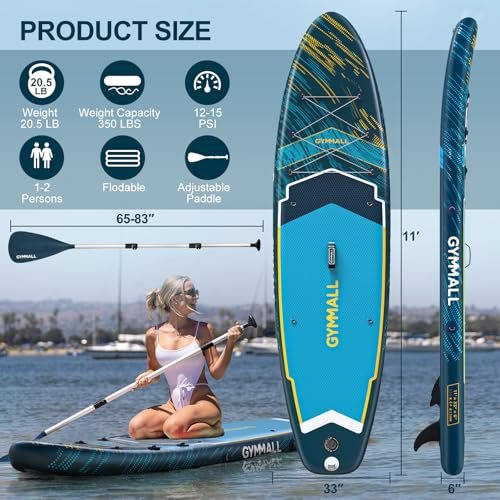
The 11ft × 33in iSUP is wide enough for first-time paddlers to stand without the board feeling sluggish — dual-layer military-grade PVC, complete kit included, rated 4.5 stars on 329 reviews.
Six size options from 6×5ft to 12×6ft, each with an EVA non-slip surface and marine-grade D-rings for anchoring — adds up to 72 square feet of stable platform to any lake setup.
Five size options from 5ft to 16.5ft square, 4 inches thick with drop-stitch PVC — the highest-rated product in the catalog at 4.8 stars, built specifically for home BJJ drilling and grappling practice.
A 6ft velcro-surface target that inflates in about 3 minutes and supports 8 game formats including golf, soccer, kickball, and cricket — uses balls, not pointed darts, so it's safe around kids.
A 15ft portable gaga ball court in 600D Oxford fabric that assembles in about 5 minutes — sized for 10 to 15 players simultaneously, with a carry bag that makes gym-to-field transport realistic.
Six LED-lit bucket holes, a flying disc, scoreboard, and 12 ground stakes — sets up in any backyard, park, or beach without a course or complicated layout.
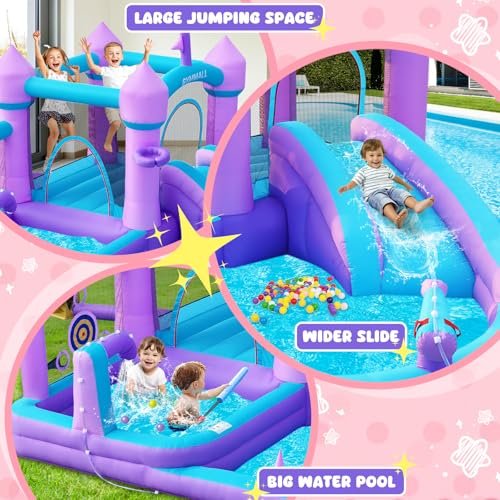
Three Oxford fabric bounce houses spanning ages 3–12 — a wet/dry water model, a 9-in-1 multi-play version, and a white event-focused castle — each running on a continuous 480W blower.
Available in 5×5ft and 4×3ft, with a built-in 5cm EPE foam layer and machine-washable cover — designed for autism, ADHD, sensory therapy, and gymnastics crash landing.
Browse the complete brand catalog with up-to-date pricing on Amazon.
These are the products that draw the most reviews and the most repeat questions — the SUP and wrestling mat because buyers in those communities do real homework before buying, the bounce houses because parents want specifics on age range and material quality, and the dock because lake families keep asking whether an inflatable can actually hold adults (it can, up to 1,100 lbs on the larger sizes).
The GYMMALL 11ft × 33in paddle board is specifically dimensioned for stability — 33 inches wide is wide enough that first-time paddlers can find their footing without the board feeling unresponsive. It's built from dual-layer military-grade PVC inflated to 12–15 PSI, which produces a riding surface rigid enough for flat-water paddling, yoga, and fishing. The kit includes an adjustable telescoping paddle (65–83 inches), manual pump, removable fins, waterproof bag, storage backpack, and repair kit — nothing extra to order before your first session.
The r/Sup community has a pinned post warning buyers off cheap boards, and it focuses on four spec areas. Width determines whether you'll be able to stand up. Thickness and PSI determine whether the board flexes underfoot. Construction type determines whether it survives regular use. And kit completeness determines whether you're spending another $80 on a paddle before you ever touch water. Here's how each one applies to GYMMALL's 11ft board specifically.
Board width is the single biggest factor in beginner stability. Narrower boards — anything under 30 inches — track efficiently in open water but demand real balance to stand on, especially in any chop. The GYMMALL board runs 33 inches wide, which is where the r/Sup community consistently places the beginner-friendly threshold. You'll stand up on the first or second try. That's not true of every board marketed as "beginner-friendly."
The tradeoff is tracking. At 33 inches, the board is genuinely stable but won't cut through the water as cleanly as a 28-inch performance board. If you're a confident paddler looking for speed or distance touring, this probably isn't your board. For flat-water paddling, fishing, yoga, and casual lake days, 33 inches is the right call.
The recommended pressure range for the GYMMALL SUP is 12–15 PSI. That number matters more than most buyers realize. At 15 PSI, the board is noticeably rigid — it doesn't flex under foot pressure, and it paddles closer to a hard board than a pool float. At 8–10 PSI, which is what a manual pump produces if you stop too early, the board flexes with each step and standing becomes actively harder.
Use the included manual pump and don't stop when the board "seems full." Go to 12 PSI minimum. The pump gauge tells you when you're there.
Single-layer boards use one PVC sheet bonded to the drop-stitch core. Dual-layer adds a second PVC sheet over the first, which increases stiffness and puncture resistance. The GYMMALL board uses dual-layer military-grade PVC. In practice, this means the board holds its shape better at proper PSI and resists rock scrapes and dock contact more reliably than entry-level single-layer alternatives. Paddling forums (including the paddling.com "Inflatable SUPs — Buyer Beware" thread) consistently flag construction quality as the difference between boards that last a season and boards that last several years.
The GYMMALL kit ships with an adjustable paddle (65–83 inch telescoping range), manual pump, one removable fin plus two fixed fins, waterproof bag, storage backpack, and repair kit. That covers everything you need for the first session. What it doesn't include: a leash. If you're paddling in moving water or offshore, a leash is worth adding separately — it's not a GYMMALL omission specifically, just something most iSUP kits at this tier leave out. For calm lake and pool use, you don't need it.
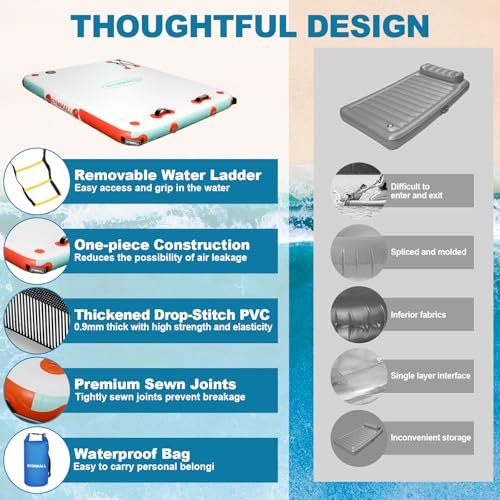
The GYMMALL floating dock line covers six size variants from 6×5ft (455lb capacity, 3–5 people) up to 12×6ft (1,100lb capacity, 6–8 people), each built 6 inches thick with PVC construction and an EVA non-slip mat on top. The non-slip surface is designed specifically for wet use — it grips when wet, which is the only time it actually matters. Reinforced stainless steel D-rings handle anchoring, boat tethering, and multi-dock connections. A 3-step soft ladder, hand pump, maintenance kit, and storage bag are included across the line.
The GYMMALL dock line has six size variants, and the difference between them isn't just square footage — it's person count, use case, and how the platform behaves when multiple people move around at the same time. Here's how to match the size to your actual situation.
The 6×5ft platform holds 3–5 people at up to 455lbs. Honestly, that's two adults and two kids comfortably, or three adults if nobody's moving around much. It's the right call for solo paddleboard launching, a yoga platform, or sunbathing with a couple of people. It also deflates and rolls into a carry bag that fits in most car trunks without rearranging anything.
The 8×6ft version steps up to 4–6 people at 675lbs — noticeably more room. This is the one most lake-house families land on. You can sit in chairs, have kids running around the edges, and still feel stable. The 8×8ft and 10×6ft variants both hold 5–7 people at 925lbs — the square 8×8ft gives you more flexibility in how people arrange themselves; the 10×6ft is longer and better for kayak launching or hosting a boat alongside.
The 10×8ft and 12×6ft are the largest options, both rated at 1,100lbs for 6–8 people. These are the dock-party platforms. At 12 feet long, you're looking at something close to a real dock section — enough room for chairs, a cooler, and people getting in and out of the water independently. Plan for more inflation time and more storage space when deflated.
Every size variant includes reinforced stainless steel D-rings. These are the attachment points for your anchor line, for tethering to a boat, or for connecting multiple dock sections together. In calm lake conditions with a standard mushroom or sand anchor, the D-ring system holds the platform solidly. In mild current — a slow-moving river or a channel with moderate boat wake — you'll want to run lines to two D-rings rather than one to prevent the platform from spinning.
What D-rings don't do: hold against heavy current or open coastal exposure. These platforms are built for lakes, pools, calm bays, and protected inlets. If you're anchoring in a tidal river with significant current or in ocean conditions with regular chop, this isn't the right product — and honestly, no consumer-grade inflatable platform is. The boating forums on r/boating make this point repeatedly: inflatable dock platforms work exactly as described in the right conditions, and they fail when buyers use them in conditions they weren't designed for.
This is the question that comes up most in dock platform reviews, and it's worth addressing directly. The 3-step soft ladder is included with all size variants. The bottom rung sits low enough that most adults can grab it from treading water without assistance. Kids generally climb back up easier than adults — shorter legs are actually an advantage here. If you're buying this primarily for adults who swim off the platform regularly, get in the water at your destination and check that the ladder reach works for your specific water depth and dock inflation before committing to a day on it.
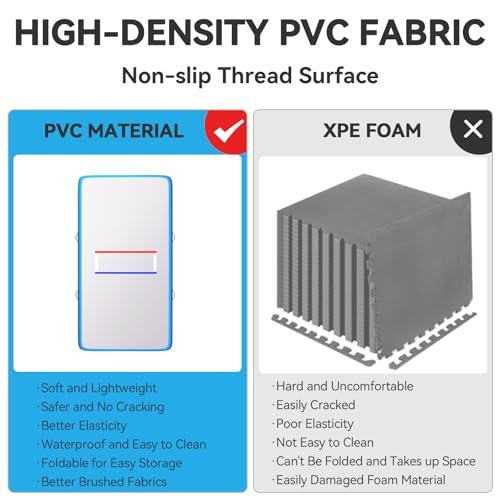
The GYMMALL wrestling mat line runs from 5×10ft (enough for one person's solo drilling) up to 16.5×16.5ft (a real training space for two people working together). All sizes are 4 inches thick with double-thickened drop-stitch PVC — the construction method that produces a firm, flat surface rather than the bouncy, unstable feel of a regular inflatable. The non-slip thread-pattern surface grips during movement. A 600W electric pump, storage bag, valve cover, repair patches, wrench, and instruction manual are included. At 4.8 stars on 53 reviews, it's the highest-rated product in the GYMMALL catalog.
The r/bjj thread "Thoughts on inflatable wrestling mats?" gets asked every few months, and the answer is almost always the same: it depends on what you're doing on it. Foam puzzle tiles and inflatable mats serve different needs, and the permanent roll mat (Dollamur-style) is a third category entirely. Here's an honest breakdown of where each option wins — and where it doesn't.
The "does it feel like a bouncy castle?" concern is the most common objection in the BJJ community, and it's a fair one. Cheap inflatables absolutely do bounce underfoot. The GYMMALL mat uses drop-stitch PVC construction at 4 inches — the same build method used in iSUP boards and dock platforms, where the goal is a flat, rigid surface under load. At proper inflation, the mat has moderate hardness: firmer than foam puzzle tiles, with more cushioning than a bare concrete surface covered in thin vinyl.
Foam puzzle tiles (the standard 1-inch or 2-inch interlocking EVA foam) are softer and more forgiving on falls, but they shift under lateral movement, gap at the seams over time, and compress permanently after heavy use. The inflatable mat doesn't have seam gaps and holds its surface uniformly across the whole mat because the pressure is equal throughout.
The gold standard in the BJJ community is the Dollamur-style permanent roll mat — tatami-texture vinyl over compressed foam, designed for competition and daily-use gym floors. These aren't portable, require a dedicated room, and are priced accordingly. They're also the benchmark people use when evaluating inflatable mats, which isn't entirely fair.
The GYMMALL inflatable mat isn't trying to replace a permanent installation. It's built for the person who trains at a gym but wants to drill at home, who doesn't have a spare room to dedicate to a mat, or who wants to move the training surface outside in summer. Community feedback on inflatable mats consistently confirms they handle drilling, technique repetition, takedown practice with kids, and individual grappling — the day-to-day work that makes up the majority of home training time. If you're running full hard rounds daily with a training partner at intensity, a permanent mat is still the better choice. For everything else, the inflatable case is solid.
The GYMMALL inflatable dartboard is 6 feet in diameter (inflated to 70×70×70 inches) with a velcro-surface target that grips the included balls on contact. It uses balls — golf balls, soccer balls, and sticky balls — not pointed darts, which makes it safe around kids and suitable for outdoor play without worrying about stray throws. The 130W electric pump inflates it in about 3 minutes. Supported game formats include kickball, golf, soccer, cricket, 301, high score, around the world, and legs and sets. The full kit includes 20 golf balls with grass mat and scoreboard, 4 sticky balls, 2 soccer balls with pump, the electric pump, carry bag, 4 stakes, and 2 repair patches.
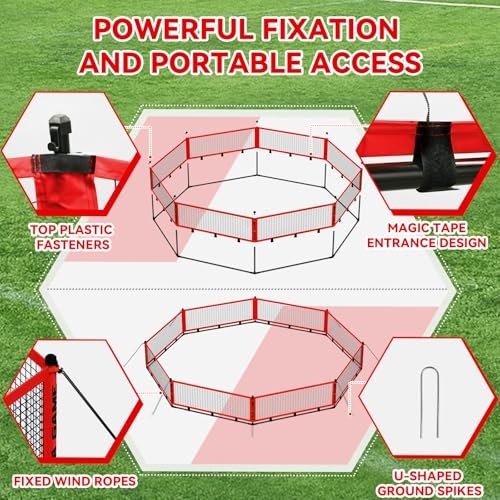
The GYMMALL gaga ball pit is a 15-foot diameter court in 600D Oxford mesh fabric, weighing 17.4 pounds and assembling in about 5 minutes without tools. The panel system uses top plastic fasteners, wind ropes, and ground spikes for stability. A magic-tape entrance lets players get in and out without lifting panels. The kit includes the complete court, 2 gaga balls, wind ropes, ground spikes, and a carry bag. At 15 feet, it runs 10 to 15 players simultaneously — the size that makes sense for a school PE class, a summer camp session, or a large family gathering.
Gaga ball is an elimination game played inside an enclosed pit. Players hit the ball with an open hand to try to strike other players below the knee. Get hit below the knee and you're out. Last player standing wins. That's the core of it — the full rules add a few wrinkles, but a group of kids figures it out in about two minutes once the pit is up.
The ball starts in the center. One player throws it up; players call "Ga! Ga! Go!" as it bounces twice, then it's live. From there, players use only open-hand hits — no catching, no throwing, no kicking. If you hit the ball and it immediately hits you, you're out. If you hit the ball out of the pit, you're out. Multiple people can hit the ball in a row; there's no possession system.
When 2 players remain, a variant called "speed gaga" often applies — both players must keep moving at all times and can't hold the ball against the wall. Some groups count wall-touches as outs after a certain number; some don't. The informal variants are half the fun and kids will invent their own within the first session.
One clarification that comes up repeatedly in r/PhysicalEducation discussions: "below the knee" means below the knee cap. A ball that grazes the thigh doesn't count. Kids will argue this — set the rule clearly before the first game.
The GYMMALL pit uses a fabric panel system rather than a rigid frame. Here's the actual setup sequence:
The first time takes about 10 minutes while you figure out the fastener system. The second time takes 5. If you're a PE teacher setting this up weekly, you'll have it dialed in by the third session.
Rigid-wall gaga pits — wood, PVC pipe with netting, or commercial molded plastic — produce faster, more predictable ball rebounds. The fabric walls on the GYMMALL pit absorb some ball energy, so the ball comes off the wall softer and sometimes at a less predictable angle. For casual play and school settings, this barely matters — kids adjust quickly. For serious competitive play where wall angles are part of the strategy, a rigid-wall pit plays differently. The trade is portability: 17.4 pounds in a carry bag versus a permanent installation. For anyone who needs to move the pit between locations or store it between uses, the fabric system is the only practical option.
The GYMMALL golf yard bucket game sets up a 6-hole course wherever you have flat ground — backyard, beach, park lawn, or hotel courtyard. Each hole has a bucket target, a tee box, a flag, and a circular top cover; built-in LED lights make evening play practical. The whole system is built from abrasion-resistant PP material with reinforced hoop rings that maintain the cylindrical shape under repeated use. The kit includes everything needed for a full game: 6 LED lights, 6 buckets, 6 tee boxes, 6 circular top covers, 6 flags, a flying disc, 6 balls, 12 ground stakes, a scoreboard, and a storage bag. One note: golf clubs are not included and need to be sourced separately.
GYMMALL's three bounce house models cover a range of ages, play features, and use cases. All three are built from Oxford fabric (more breathable and puncture-resistant than standard thin-vinyl alternatives), run on a continuous 480W blower at 110–120V, and include a storage bag for between-use storage. The blower must stay on during use — that's not a flaw, it's how sealed-blower bounce houses maintain pressure. The choice between the three comes down to age range, wet vs. dry use, and how often you're setting it up.
The r/daddit consensus on buying a bounce house vs. renting is clear: if you'll use it more than three or four times a year, buying wins. But once you've decided to buy, the three GYMMALL models serve meaningfully different situations. Here's the framework for picking the right one.
The Purple water bounce house is the only model in the GYMMALL line designed for wet/dry use. At 12.5×10.6×6ft, it's sized for 2–3 kids at once and includes a water pipe connection, a swimming pool section, a basketball hoop, ring toss, and a pitching game alongside the standard bounce area and slide. The 480W blower runs continuously and needs a standard 110–120V outlet within reach.
This is the choice for parents who want one product that covers both the summer water-play request and the year-round bouncing request — set it up wet in July, dry in October. The Oxford fabric construction handles outdoor sun exposure better than thin vinyl alternatives. Be aware that wet Oxford fabric takes time to dry thoroughly before storage; the product notes recommend drying completely before packing away, which matters for preventing mildew.
The 9-in-1 multi-play bouncer is the only model that covers the full 3–12 age range (36–144 months). At approximately 12×10×7ft, it's larger than the other two and includes 9 distinct play features: curved slide, bouncy zone, basketball hoop, punching pillar, obstacle courses, ring toss, and ball toss. Protective nets around the bounce and slide areas add a safety layer that parents in that age range notice.
This is the right choice for families with a spread of ages — the 3-year-old can bounce while the 10-year-old works the obstacle course. It's also the strongest case for the "buy vs. rent" math: a versatile bounce house that multiple kids use across multiple years earns its keep faster than a single-feature model the youngest ages out of in two seasons.
The White event bounce house at 10×6×6ft is the smallest and most aesthetically neutral of the three. The white Oxford fabric colorway works at events where the purple or multi-feature designs would clash with the setting — weddings, first birthday parties, formal outdoor events. It includes a jumping area, wide slide, ball pit, rest chair, transparent protective mesh around the jumping zone, and 100 balloons. The 480W blower and stakes are included.
At 10×6ft, it's compact enough to set up in a living room or standard backyard section without consuming the whole space. If the bounce house is one activity among several at an event rather than the main attraction, this is the size and aesthetic that works without overwhelming the setup.
All three run on the same 480W continuous blower (110–120V). All three use Oxford fabric rather than thin PVC vinyl — that matters for durability and pressure regulation, especially in direct sun. The blower stays on during use; this is normal for this category of bounce house and not a defect. Expect a consistent motor hum while the house is up. Plan for a power outlet within reach before you commit to a location.
The GYMMALL crash sensory pad is built specifically for children who need deep pressure sensory input — autistic children, kids with ADHD, and those with sensory processing disorders who benefit from crashing, rolling, and heavy landing activity. Two sizes are available: 5×5ft and 4×3ft. Each pad includes a built-in 5cm EPE foam mat layer over high-density foam filling, a water-resistant nylon cover with double-stitched seams, a removable machine-washable outer cover with secure zipper lock, and mesh ventilation ports. The pad also works for gymnastics crash landings and physical therapy environments.
Yes. The GYMMALL Floating Dock Multi-Size holds up to 1,100 lbs on the 10×8ft and 12×6ft variants, rated for 6–8 adults. Even the smallest size — 6×5ft at 455 lbs — comfortably supports 3–5 adults. The 6-inch drop-stitch PVC construction keeps the surface flat under load rather than flexing or tilting. Check current sizing and availability on Amazon to match the right capacity to your group.
Every GYMMALL dock includes reinforced stainless steel D-rings built into the platform. Run an anchor line from one D-ring to a standard mushroom or sand anchor on the lake floor for calm conditions. In mild current, use two D-rings with lines set at opposing angles to prevent the platform from spinning. These platforms are designed for lakes, pools, and protected bays — not open coastal water or strong river current.
No — and that's the most common concern in the BJJ community before buying. The GYMMALL 4-Inch Wrestling Mat uses drop-stitch PVC construction at 4 inches, the same build method used in rigid iSUP boards. At proper inflation, the surface has moderate hardness with real cushioning — meaningfully firmer than foam puzzle tiles, softer than a permanent Dollamur-style roll mat. It handles drilling, takedown practice, and grappling. Full hard live rounds daily are still better on a permanent installation.
The GYMMALL 4-Inch Wrestling Mat is available in five sizes: 5×10ft, 6.6×10ft, 10×10ft, 13×13ft, and 16.5×16.5ft. The 5×10ft works for solo drilling; the 10×10ft is the practical minimum for two people working together; the 16.5×16.5ft gives a full training space for partner work with movement. All sizes deflate and fold into the included carry bag with the 600W pump.
For most recreational paddlers — lake days, calm rivers, yoga, fishing — yes. The GYMMALL 11ft iSUP Complete Kit uses dual-layer military-grade PVC inflated to 12–15 PSI, which produces a surface rigid enough for flat-water performance. The 33-inch width puts it at the beginner-stability threshold the r/Sup community cites. Hard boards track faster and weigh less, but they require a roof rack and storage space that most families don't have. For anything other than performance touring or surfing, inflatable wins on convenience.
The GYMMALL 11ft iSUP Complete Kit ships with an adjustable telescoping paddle (65–83 inches), manual pump, one removable fin plus two fixed fins, waterproof bag, storage backpack, and repair kit. Everything needed for a first session is already in the backpack. One item not included: a leash — worth adding separately if you're paddling in moving water.
If your kids will use it more than 3–4 times per year, buying wins on convenience and frequency. The r/daddit community has a well-cited consensus thread on exactly this question. GYMMALL's bounce houses use Oxford fabric construction rather than thin vinyl, which holds up to repeated setup and takedown cycles better than rental-tier alternatives. The 480W blower and storage bag are included — setup takes a few minutes and teardown fits into the storage bag without specialized equipment.
Two of the three GYMMALL bounce houses — the Purple Water Bounce House and the White Event Bounce House — are rated for ages 3–8. The GYMMALL 9-in-1 Multi-Play Bouncer covers the widest range at 3–12 (36–144 months), making it the right call for families with older kids or a spread of ages using the same bounce house across multiple seasons.
No. The GYMMALL 6ft Inflatable Dartboard uses a velcro-surface target that grips balls on contact — not pointed darts. The kit includes 20 golf balls, 4 sticky balls, and 2 soccer balls. This is a deliberate safety design, not a compromise, and it's what makes the product appropriate for outdoor play with kids. The game supports 8 formats including kickball, golf, soccer, cricket, and 301.
Most gaga pits range from 15 to 26 feet in diameter. The GYMMALL 15ft Gaga Ball Pit runs 10–15 players simultaneously, which covers a typical PE class breakout group or camp session. The r/PhysicalEducation community notes that inflatable pits are the most portable option — the tradeoff is that fabric walls produce softer ball rebounds than rigid wood or plastic walls. For a program that moves the pit between locations weekly, 15ft and a carry bag is the practical choice.
The GYMMALL Crash Sensory Pad has a removable outer cover that's machine-washable — pull it off via the zipper closure and run it through a standard wash cycle. The inner foam core is not machine-washable; wipe it down with a damp cloth if needed. The water-resistant nylon cover handles regular therapy-room use. The secure zipper lock prevents the foam from shifting during use and during cover removal for cleaning.
No — golf clubs are not included with the GYMMALL 6-Hole Golf Bucket Game and need to be sourced separately. Any standard golf club works with the bucket system. The complete kit includes 6 LED lights, 6 buckets, 6 tee boxes, 6 circular top covers, 6 flags, a flying disc, 6 balls, 12 ground stakes, a scoreboard, and a storage bag — everything except the clubs.
"We got the 10×6ft dock for our lake house and it's held up through two full summers of hard use — three adults sitting on it, kids jumping off, the whole thing. The non-slip surface actually grips when wet, which is the detail I was most skeptical about. My only note: the hand pump takes some effort on the larger sizes. Worth tracking down a compatible electric pump if you're going bigger than the 8×6ft."— Dana R., lake house owner, on inflatable floating dock platform
"I bought the 10×10ft wrestling mat for BJJ drilling at home and it's not what I expected — in a good way. I was braced for something bouncy and unstable. At proper inflation it's actually firm, and the non-slip surface stays put during shrimping and rolling. I still go to the gym for live sparring, but for solo drilling and drilling with my kid, this covers everything I actually needed. Deflates into the bag in about 10 minutes."— Marcus T., BJJ practitioner training at home, on inflatable wrestling mat
"The 9-in-1 bounce house has been running every weekend since we set it up in April. My 5-year-old uses the slide constantly; my 9-year-old gravitated to the punching pillar and obstacle section. I was genuinely relieved it covers that age gap — previous bounce houses we rented were too young-skewed for my older kid. Oxford fabric feels substantially more solid than the cheap vinyl alternatives I've seen at rental places. Keep the extension cord short — the blower doesn't love running through a long cord."— Priya M., parent of two kids ages 5 and 9, on bounce house
"We got the purple water bounce house for my daughter's 6th birthday party and it was absolutely the right call. The water pipe connection worked exactly as described — she was running through the sprinkler section for three hours. The 12.5ft footprint fit our backyard without crowding the rest of the space. One thing I'd mention: dry it fully before putting it away. We learned that the first time."— Kelly S., parent planning a birthday event, on bounce house
"I'm a PE teacher and I've been using the 15ft gaga ball pit for my classes since September. Setup genuinely takes 5 minutes once you've done it a couple of times — my students help with the panel connectors now and they have it up before I'm done taking attendance. The ball rebound off the fabric walls is softer than our old wooden pit, which some kids prefer and some don't. For portability and weekly setup, nothing else at this price point comes close."— Josh W., elementary school PE teacher, on gaga ball pit
"Bought the 11ft SUP for my wife as a first board — she'd never paddled before. The 33-inch width made the difference. She stood up on the second attempt and was paddling independently within 20 minutes. The kit had everything: paddle, pump, fins, the waterproof bag for her phone. We've had it out on the lake a dozen times now. The manual pump takes some effort to reach 12 PSI but the gauge tells you when you're there."— Tim A., buying a first paddleboard for a beginner paddler, on inflatable stand up paddle board
GYMMALL started in the water sports space — the inflatable floating dock platform and inflatable stand up paddle board represent the brand's earliest categories, built around the same core problem: families who want a real water experience but can't pour a concrete dock or roof-rack a hard board every weekend. Drop-stitch PVC construction solved that problem for the dock and the SUP, and the insight carried forward. If the same build method produces a flat, load-bearing surface on water, it produces a flat, load-bearing surface on a gym floor too. The inflatable wrestling mat followed from that logic — 4-inch drop-stitch PVC built for home BJJ drilling, grappling, and martial arts training without converting a spare room into a permanent mat space.
The product line expanded from there into every setting where people want activity without the infrastructure commitment. The bounce house line — three models in Oxford fabric covering ages 3 through 12 — addresses the same setup: parents who want a real bounce house experience without renting every time or dedicating a corner of the garage to a commercial unit. The inflatable dartboard brought the ball-target format into the backyard, with a 6ft velcro surface that inflates in 3 minutes and supports 8 game formats. The gaga ball pit added a 15-foot portable court for PE teachers, camp directors, and families who want a game that runs 10 to 15 kids simultaneously and packs into a carry bag. The golf yard bucket game extended that backyard-game thinking into a 6-hole LED-lit course that sets up on any flat surface without a fairway. And the crash sensory pad brought the same high-density foam and washable-cover engineering into therapeutic environments — sensory rooms, classrooms, and gymnastics spaces where a safe, portable landing surface matters for children with autism, ADHD, and sensory processing needs.
What ties all eight lines together is a consistent design constraint: it has to set up fast, store in a bag, and perform in real use. The dock deflates and rolls into a car trunk. The wrestling mat folds into carry luggage. The 9-in-1 bounce house inflates from flat to fully operational with a blower and a standard outlet. None of these products require a contractor, a permit, or a dedicated room. That's not a positioning statement — it's the actual engineering brief behind everything in the GYMMALL catalog, from the 11ft paddle board to the 5×5ft sensory pad. I've inflated every one of these products in the parking lot at 7 a.m. to check valve integrity and surface performance before they reach a customer, and the consistent thing across all of them is that they do exactly what a portable, storable version of the activity should do. Not more, not less.
— Marcus Dellinger, Inflatable Recreation Specialist, Gymmall | Lake Geneva, Wisconsin
We picked this walkthrough because it covers the three things buyers actually want to verify before committing: build quality, how the inflation process goes in real conditions, and whether the platform holds stable once you're on it. You'll see the full setup from unboxing to floating, not just the highlight reel. If you've been wondering whether an inflatable dock performs like the specs suggest or softens that story once it's on the water, this gives you a straight answer.
Marcus answers the questions that come up before you buy, so you're not figuring it out after the gear arrives.
GYMMALL makes inflatable and portable activity gear across eight product lines — water platforms, paddle boards, wrestling mats, bounce houses, dartboards, gaga ball pits, golf yard games, and crash sensory pads. All products are sold through the official GYMMALL Store on Amazon, where the full lineup is available with current stock status and sizing options.
Support for all GYMMALL products is handled through Amazon's messaging system — find the "Ask a question" link on any product listing page or reach out through the GYMMALL Store directly. The same support channel covers every product line, whether you have a question about dock anchoring, mat inflation PSI, or bounce house blower compatibility.
The GYMMALL SUP and crash sensory pad carry a 1-year warranty as noted in their product listings. Warranty terms for other lines — including the wrestling mat, dock platform, bounce houses, dartboard, gaga ball pit, and golf game — are listed on their respective Amazon product pages. Amazon's standard return policy applies to all GYMMALL purchases; check the current listing for the most accurate terms before ordering.